
Critique-based Revision: An Example
Issue #58, Critique & Revision, 3 of 3


When you get right down to it, it’s all about change, isn’t it? If we rigidly stick with first instincts and refuse to consider suggestions and other points of view, we often let ourselves down—and this is true whether we’re discussing novel drafts or life itself.

I always solicit feedback on my fiction, and when I get it, I consider every comment seriously and prepare to revise my words based on what I hear.

Let’s illustrate this critique/revision process with another example from my own writing. Again, this centers on Word’s review pane, the usual method by which I give and get critiques (see Writing Rhythm Issue #56).
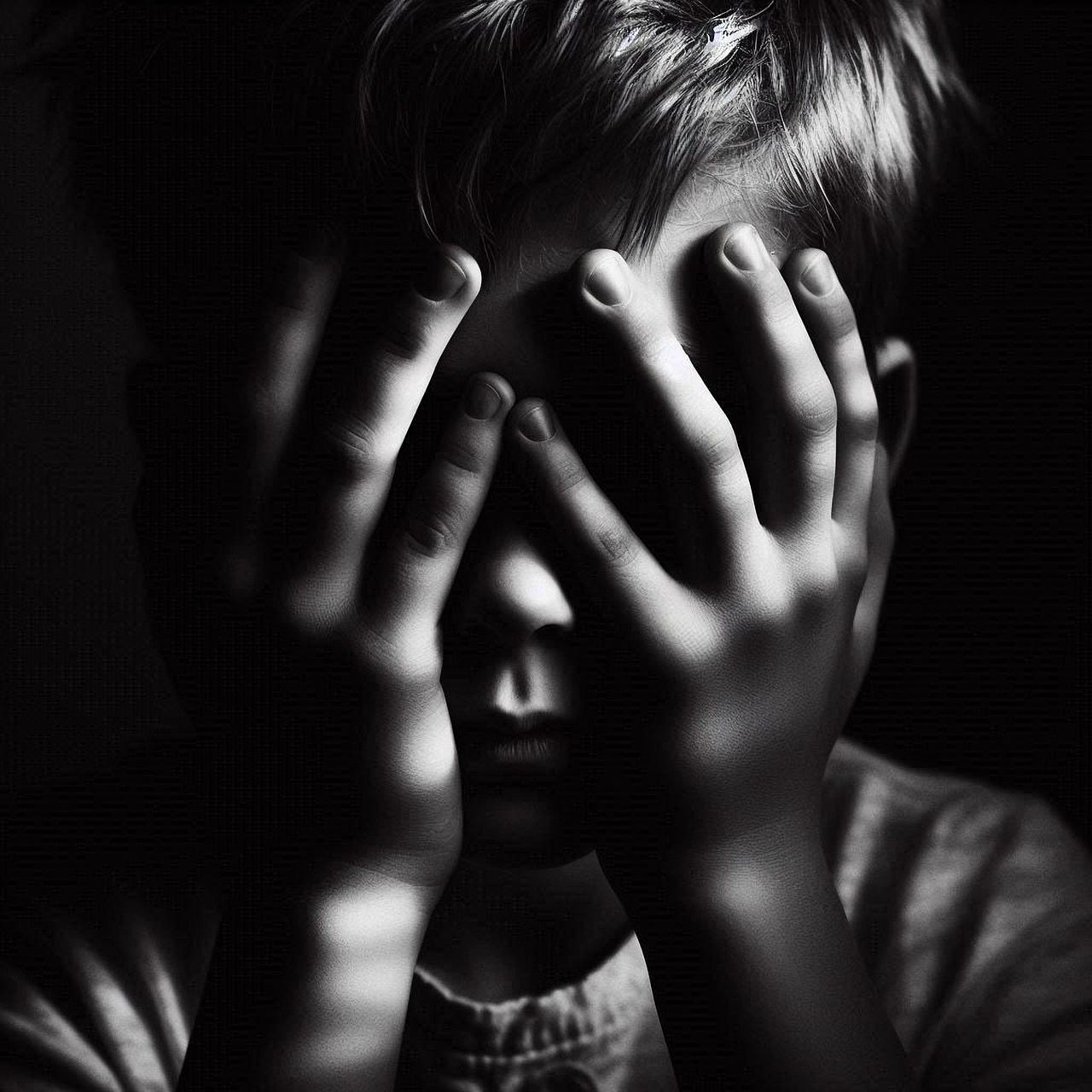
The following is a short excerpt from a long horror piece. The focus of this chapter was a trope—or a recurring theme, sometimes overused—known as “black-eyed children” (if you’re not familiar, look ’em up if you want a chill). Anyway, our characters, Brian and his wife Gwen, have come for the first time upon a certain haunted hunting lodge. Brian has just impulsively pulled the rope on the old-school bell by the door.
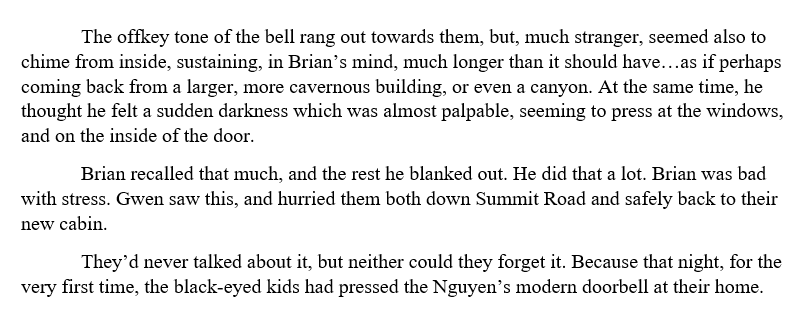
Stop for a moment and imagine if you were critiquing this piece. What do you see in these few short lines that calls attention to itself, good or bad? If you were in my writing group (Writing Rhythm Issues #29 – 32), or if you were my Alpha or Beta reader (Writing Rhythm Issue # 52) or my Critique Partner (Writing Rhythm Issue #53), what would you tell the author—me—about it? Do you have suggestions, or see things that are unclear or need tweaking?
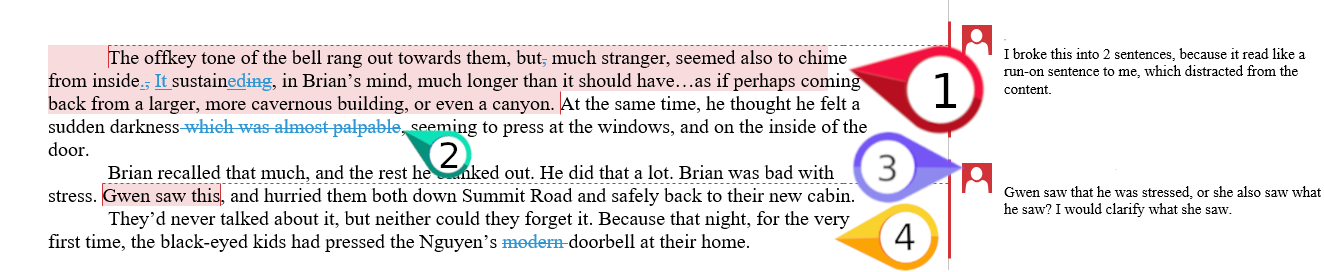
For this project I had a wonderful CP, or Critique Partner (she’ll stay anonymous) who offered the following, as shown in the review pane option on Word. I’ve added numbers, the better to discuss each point.
You need to know upfront that reviewing suggestions is the painful part of the process. I suspect most writers, like me, hope that critiques might somehow be all-positive, and thus necessitate no revision. But it never turns out that way.
1) I decided the long sentence above was indeed a run-on.
2) My critique partner suggested deleting this “palpable” phrase, and after careful consideration, I agreed.
3) Again, I decided that this point was a good one. This passage was unclear, and needed reworking.
4) In this case, I disagreed. To me, the word “modern” reminds the reader that we’re back at the Nguyen’s newer cabin, and no longer at the old lodge. I left it as is.
Which leads to an important observation, in the form of a tip.

Writing Tip
Critique comments are only suggestions. You should consider each one, but you DO NOT automatically have to accept them.
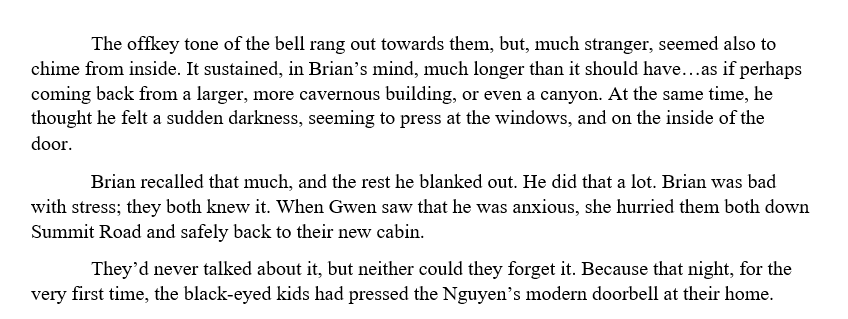
Here’s the finished revision.
That cheerful thought brings us to this issue’s version of an ongoing Writing Rhythm feature—which hopefully you don’t think I’ve overused to the point where it’s become a cliché. And yes, that’s a hint.

What is a trope?
Action Plan:

Please patronize the talented Unsplash photographers who illustrate these pages!
For the upcoming issue, we have another in our “Keeping on Track” series in which we pause to offer tips and inspiration.
Next Up:

59) Review—and New Ideas, Keeping on Track #3
See you in two weeks!
—Craig
I am a member of several writing groups. Yet I never critique, but instead say, "the standard advice is to limit the use of commas" or "the standard advice is show, not tell". Whether or not I like the writing would probably not be helpful. After all, I can't stand Stephen King or JK Rowling : )